Arkhia, a 65-metre ground-penetrating radar system

A unique system designed for large-scale ground-penetrating radar surveying. 65 metres wide, multi-frequency antennas, agricultural traction.

Principle

Arkhia deploys a rigid 65-metre structure equipped with a dense array of GPR antennas; it records continuous profiles across several dozen hectares per day. The radar emits short electromagnetic pulses into the ground and receives their echoes: every buried structure returns a characteristic signal, allowing it to be mapped without any excavation.

An array of 214 antenna pairs

a) Operating principle
1. One pair of bowtie antennas per housing Click to zoom in Tx Rx ground buried structure pulse echo 2. Two 65-metre rails High-frequency rail (HF) · 130 pairs spacing between the two rails Low-frequency rail (LF) · 84 pairs 65 metres
Figure 1. Indicative layout of bowtie antenna pairs (Tx/Rx) along Arkhia’s two rails: 130 high-frequency pairs and 84 low-frequency pairs, for a total of 214 active pairs across 65 metres.
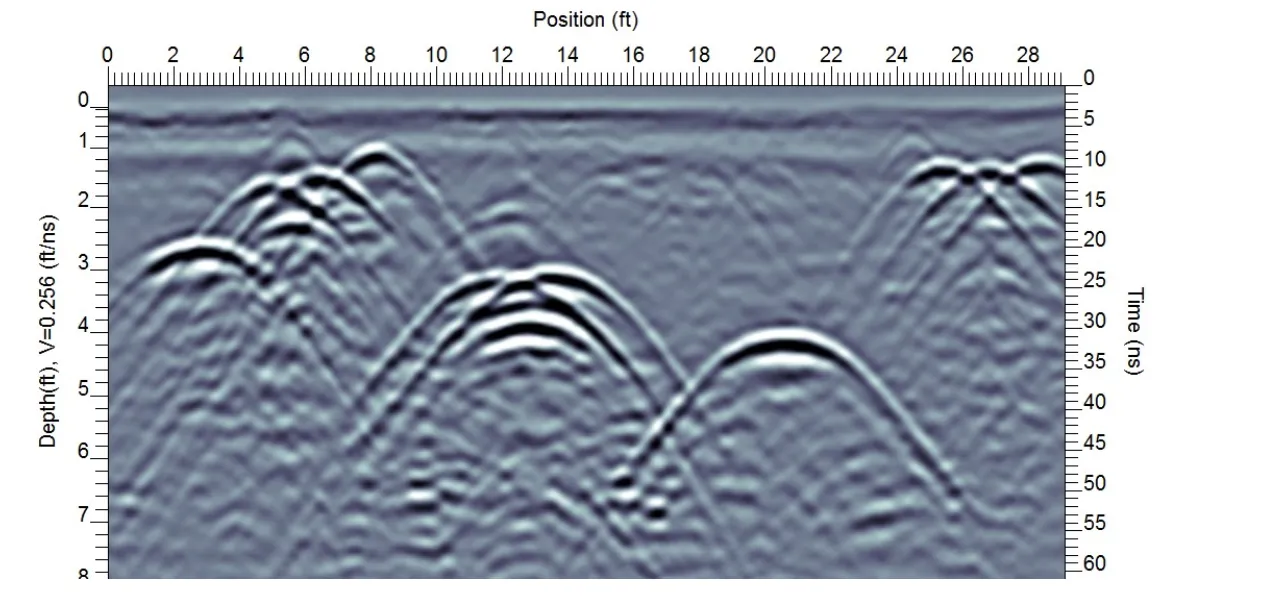
b) Raw GPR data
Cross-section of a GPR acquisition showing reflection hyperbolae
Figure 2. Multiple targets generate numerous characteristic hyperbolic responses.

A composite structure

To reach 65 metres of span while remaining towable, the structure is made of glass-fibre composite (GFRP): light, rigid and immune to electromagnetic interference, an essential asset for a radar instrument.

Detail of a joint in the glass-fibre composite structure
Figure 3. Detail of an assembly joint in the glass-fibre composite (GFRP) structure: pultruded tubes, triangulated gusset and stainless-steel bolting.

A robotised survey

To cover vast surfaces, the system is designed to be towed by next-generation autonomous tractors, akin to the agricultural robots deployed in fields today.

Precision agriculture meets archaeology: a regular, reproducible sweep at the scale of the landscape, in order to support archaeologists.

AgXeed T2 5-SERIES autonomous tractor in a field
AgXeed T2 5-SERIES, www.agxeed.com